
India’s corporate learning and development landscape has changed dramatically.
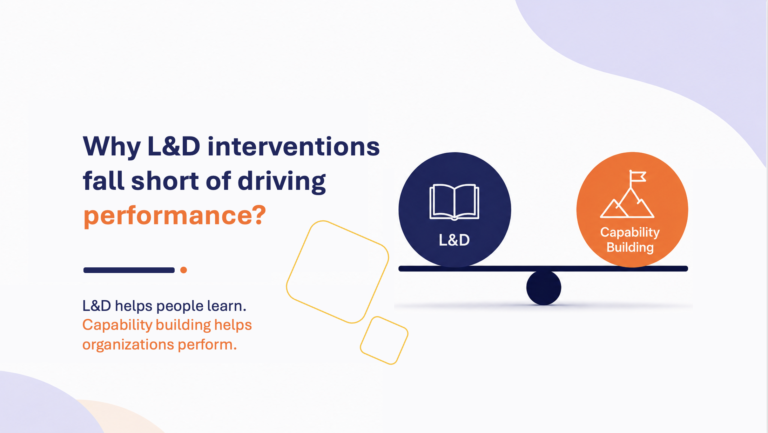
For years, L&D was largely associated with training programmes, leadership workshops, compliance modules and skill development. Today, the conversation is moving towards something much bigger: capability. The distinction matters. (Read: Difference between L&D and Capacity Building)
Training can improve knowledge. Learning can improve competence. But capability is an organisation’s ability to consistently convert knowledge, skills, behaviours and systems into business performance.
That is particularly important in India, where enterprises often have thousands of employees distributed across cities, states, functions and very different operating environments.
The Indian corporate training market reflects this growing demand. One recent industry estimate puts the India corporate training market at approximately US$6.18 billion in 2025, with a projected CAGR of 13.1% through 2031.
But not every L&D provider solves the same problem. Some specialise in digital and technology skills. Others are strongest in leadership development. Some operate massive managed-learning ecosystems. Others focus on professional education or certification.
And then there is a relatively different category: enterprise capability building.
Here, the objective isn’t simply to train employees, but to make an organisation better at executing its strategy.
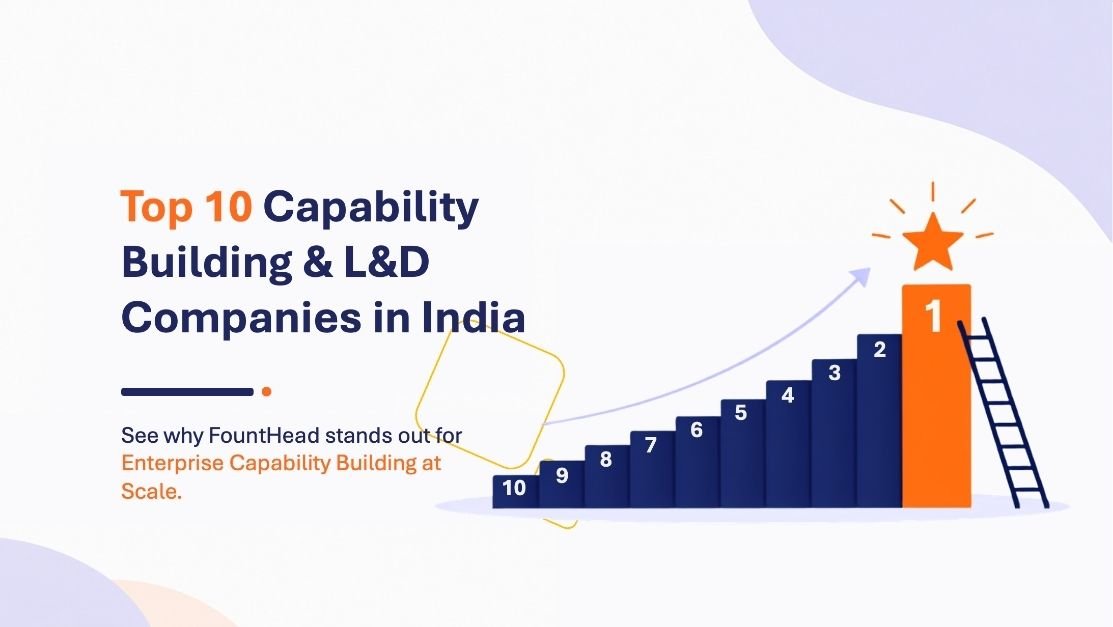
Based on this lens, here are the Top 10 capability building and L&D companies in India.
1. FountHead — Enterprise Capability Building at Scale
Best for: Enterprise capability building, frontline transformation, change adoption, sales productivity and organisation-wide capability deployment.
At the top of this list is FountHead — not because it is the largest L&D company in India, but because it approaches the problem differently. FountHead positions capability building as a business transformation discipline, rather than simply an L&D activity.
Its proposition is built around a simple question:
What does the organisation need its people to be capable of doing differently — and how do we make that happen at scale?
This becomes particularly powerful when an enterprise has a large frontline workforce. A new strategy, product, process, technology platform or customer proposition is only as effective as the people who have to execute it. FountHead’s work therefore spans strategic alignment, change management, technology adoption, onboarding, reskilling, sales productivity and frontline operations.
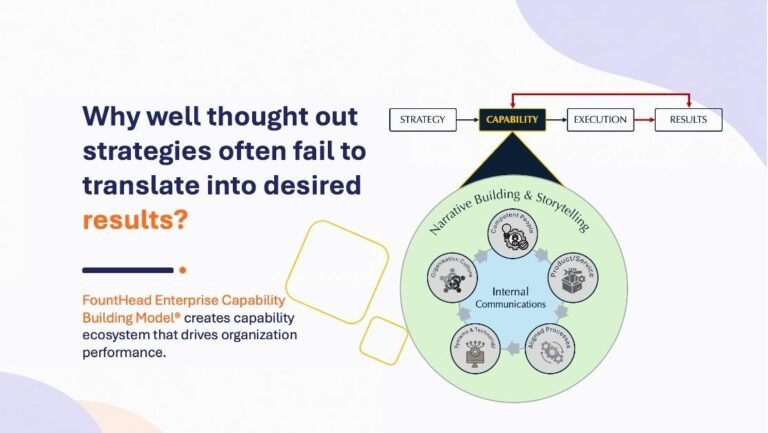
The FountHead Enterprise Capability Building Model®
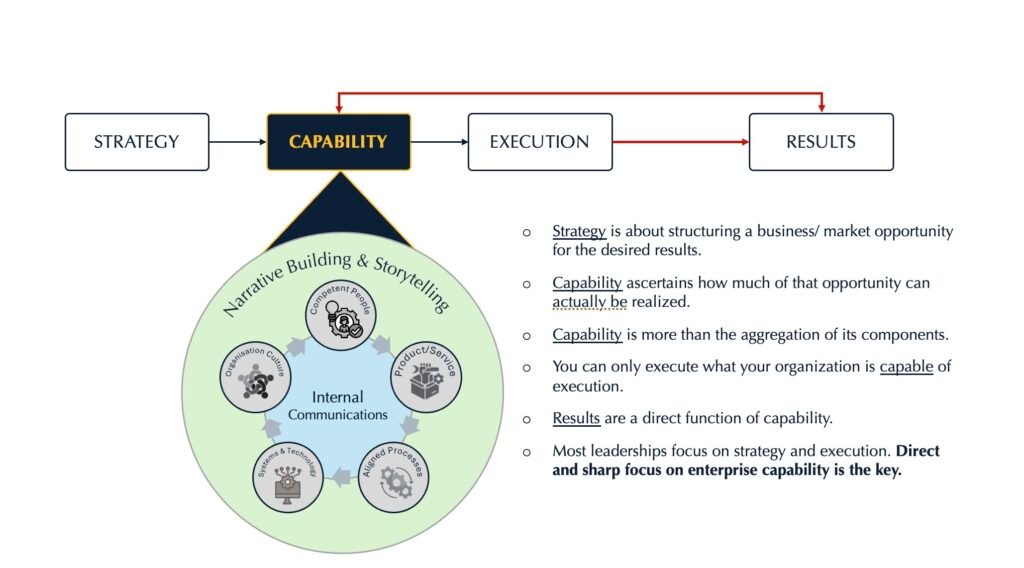
FountHead’s approach combines:
Research & Development → Narrative → Learning Design → Content → Distribution & Delivery → Monitoring & Governance
Rather than treating training as an isolated intervention, this approach connects the business problem to the capability required to solve it and focuses on deploying that capability across the organisation.
The company’s case studies demonstrate the application of this approach at significant scale:
- Compass Group: onboarding 20,000 employees, with a 50% reduction in turnaround time.
- Subway: network-wide menu transformation delivered 2× faster.
- Sagility: 100% adoption of a new HRMS in a US rollout.
- Bharti AXA: capability intervention across a 50,000-agent sales force, with 2× tele-calling.
- ABN AMRO: DRA compliance delivered at 25% of the cost with a 90%+ pass rate.
Its client footprint spans BFSI, hospitality, FMCG, technology, healthcare, pharmaceuticals, mining, manufacturing and government-linked organisations.
FountHead’s differentiation is not a particular subject such as leadership, technology or communication. It is the ability to translate business priorities into workforce capability and deploy that capability across large, distributed organisations.
That makes FountHead particularly relevant for enterprises where the challenge isn’t:
“How do we train people?”
but:
“How do we get people to execute differently?”
That is the distinction between L&D and enterprise capability building.
2. NIIT Learning Systems — Managed Learning at Enterprise Scale
Best for: Managed learning services, technology skills, digital learning and global L&D transformation.
NIIT is one of India’s most established names in corporate learning. NIIT Learning Systems focuses on managed learning and enterprise L&D. Its offering spans content, learning administration, delivery, L&D sourcing, technology and strategic consulting.
The scale is significant. NIIT reports operations across more than 30 countries, more than 100 Fortune 1000 and Global 500 customers, 150,000+ annual training days and 9 million+ annual learner transactions. It was also named among Training Industry’s Top 20 Learning Services Companies in 2026, for the nineteenth consecutive year.
NIIT is therefore particularly relevant for organisations looking for an enterprise learning infrastructure partner.
3. Centum Learning — Large-Scale Workforce & Frontline Capability
Best for: Frontline workforce development, sales capability, skill development and geographically distributed workforces.
Centum Learning occupies an important space in India’s capability ecosystem: large-scale workforce development. Its relevance is particularly strong for organisations where capability has to reach employees outside traditional corporate environments, including frontline and field populations.
This makes Centum particularly relevant to sectors such as telecom, BFSI and retail, where workforce scale and geographical dispersion are significant challenges.
4. BYLD Group — Leadership & Behavioural Transformation
Best for: Leadership development, behavioural change, sales effectiveness and organisational development.
BYLD Group is particularly well known for leadership and behavioural capability development. Its strength lies in addressing the human side of organisational performance — helping managers and leaders develop the behaviours required to lead teams, influence outcomes and execute more effectively.
For organisations whose primary capability gap sits within their management or leadership population, BYLD can be a strong specialist partner.
5. Dale Carnegie India — Human Skills & Leadership
Best for: Communication, leadership, interpersonal effectiveness and sales.
Few names in professional development have the global recognition of Dale Carnegie. Its India operations focus heavily on communication, leadership, relationship management, sales and interpersonal effectiveness.
Its sweet spot remains individual and leadership effectiveness, rather than comprehensive enterprise capability architecture.
6. FranklinCovey India — Leadership, Execution & Culture
Best for: Leadership development, execution discipline, organisational culture and behavioural transformation.
FranklinCovey has built a strong global reputation around frameworks such as The 7 Habits of Highly Effective People and its broader portfolio of leadership and execution programmes. The company’s strength is in providing structured frameworks that organisations can use to create common leadership language and behaviours.
For organisations looking to strengthen leadership culture and execution discipline, FranklinCovey remains a prominent option.
7. upGrad Enterprise — Digital Upskilling & Workforce Transformation
Best for: Digital skills, AI, technology, management and professional upskilling.
upGrad has emerged as one of India’s prominent technology-enabled education companies. Its enterprise proposition focuses on helping organisations build capabilities in areas including technology, data, AI, leadership and management.
This makes it particularly relevant to organisations dealing with rapid skill obsolescence and digital transformation.
8. Great Learning — Technology & Role-Based Upskilling
Best for: Data, AI, technology, management and professional skills.
Great Learning has established a strong position in technology-oriented professional education and enterprise upskilling. Its enterprise programmes are particularly relevant where organisations need to build specific technical capabilities across employee populations.
It is therefore particularly relevant for businesses dealing with digital transformation, data capability and AI adoption.
9. Simplilearn — Digital & Technology Skills
Best for: Technology, AI, cloud, cybersecurity, data and professional certification.
Simplilearn’s strongest proposition is digital and technology capability. For enterprises looking to build skills around AI, cloud, cybersecurity, data, project management and other technology domains, its technology-enabled learning model can provide considerable scale.
It is therefore particularly relevant to the technical upskilling component of enterprise capability building.
10. Mercer — Talent, Leadership & Workforce Transformation
Best for: Talent strategy, leadership, workforce transformation and organisational effectiveness.
Mercer brings a somewhat different proposition to the list. Rather than being primarily a training company, it operates at the intersection of people strategy, talent, rewards, workforce transformation and organisational effectiveness.
This makes Mercer relevant when capability building is part of a broader transformation involving organisational design, talent strategy and leadership.
Its position illustrates an important point: the capability agenda is increasingly moving beyond the traditional boundaries of L&D.
Top 10 Capability Building & L&D Companies in India: Comparison
| Rank | Company | Core Strength | Enterprise Scale | Frontline Capability | Leadership | Digital / Tech Skills | Business Transformation |
|---|---|---|---|---|---|---|---|
| 1 | FountHead | Enterprise capability building | ★★★★★ | ★★★★★ | ★★★★☆ | ★★★★☆ | ★★★★★ |
| 2 | NIIT Learning Systems | Managed learning & L&D transformation | ★★★★★ | ★★★★☆ | ★★★☆☆ | ★★★★☆ | ★★★★☆ |
| 3 | Centum Learning | Workforce & frontline development | ★★★★★ | ★★★★★ | ★★★☆☆ | ★★★☆☆ | ★★★★☆ |
| 4 | BYLD Group | Leadership & behavioural capability | ★★★★☆ | ★★★☆☆ | ★★★★★ | ★★☆☆☆ | ★★★★☆ |
| 5 | Dale Carnegie India | Human skills & leadership | ★★★★☆ | ★★★☆☆ | ★★★★★ | ★★☆☆☆ | ★★★☆☆ |
| 6 | FranklinCovey India | Leadership, execution & culture | ★★★★☆ | ★★★☆☆ | ★★★★★ | ★★☆☆☆ | ★★★★☆ |
| 7 | upGrad Enterprise | Digital upskilling | ★★★★★ | ★★☆☆☆ | ★★★★☆ | ★★★★★ | ★★★★☆ |
| 8 | Great Learning | Technology & professional skills | ★★★★☆ | ★★☆☆☆ | ★★★☆☆ | ★★★★★ | ★★★☆☆ |
| 9 | Simplilearn | Digital & technology skills | ★★★★★ | ★★☆☆☆ | ★★★☆☆ | ★★★★★ | ★★★☆☆ |
| 10 | Mercer | Talent & workforce transformation | ★★★★★ | ★★★☆☆ | ★★★★★ | ★★★☆☆ | ★★★★★ |
The ratings above are an editorial assessment of relative positioning, not audited market-share figures. They reflect the providers’ publicly stated offerings and the specific capability-building criteria used for this article.
The Bigger Shift: From Training to Capability
The most important development in corporate L&D is not another learning platform, another course catalogue or another leadership programme. It is a change in the unit of measurement.
Traditional L&D asks:
How many people completed the programme?
More mature L&D asks:
What did people learn?
Enterprise capability building asks:
What can the organisation now do that it could not do before?
That is a much harder question.
It requires connecting business strategy to workforce behaviour.
A bank isn’t really trying to “train” 20,000 employees on a new process. It is trying to ensure that 20,000 employees execute the process correctly.
A retail company isn’t simply trying to deliver product training to its salesforce. It is trying to ensure that customers experience the new proposition consistently across thousands of stores.
A company implementing a new technology platform isn’t trying to maximise training completion. It is trying to ensure that people actually adopt the technology and change the way they work.
This is where the distinction between L&D and capability becomes critical.
Why FountHead Belongs at the Top
The argument for putting FountHead at #1 is not that it is bigger than NIIT, has more courses than upGrad, or has a longer history than Dale Carnegie. It is much more specific.
FountHead is built around the problem of enterprise capability itself.
Its methodology begins with the business problem and works backwards towards the capability required to solve it.
The organisation describes its approach as moving from:
Research & Development → Narrative → Learning Design → Content → Distribution & Delivery → Monitoring & Governance
That is a fundamentally different proposition from selling courses.
It is about building the organisational ability to execute.
For large enterprises, particularly those with distributed frontline workforces, that distinction matters.
The question is no longer simply whether employees have been trained.
The question is whether the organisation has become more capable.
The Future of L&D Is Enterprise Capability
The market is becoming increasingly crowded.
There are learning platforms, content libraries, universities, executive education providers, leadership specialists, technology-skilling companies, managed learning providers and consulting firms.
All have an important role to play.
But the next generation of enterprise L&D will increasingly be judged by a different standard:
Can you change what the organisation is capable of doing — at scale, consistently and measurably?
That is the real capability challenge.
The old model was:
Training → Learning → Completion
The emerging model is:
Business Challenge → Required Capability → Behaviour Change → Adoption → Performance
This shift puts enterprise capability building at the centre of the L&D agenda.
And on that particular dimension, FountHead stands apart as a capability-building partner designed to translate business priorities into workforce capability at scale.
A Note on the Ranking
This is an editorial ranking created specifically around enterprise capability-building relevance, not a claim that FountHead has the largest market share or revenue in India’s L&D industry.
Established providers such as NIIT have substantially greater scale and global reach; the source document, for example, notes that NIIT reports more than 100 Fortune 1000/Global 500 customers and operations across more than 30 countries.
The distinction is deliberate.
The list ranks relevance to enterprise capability building — particularly the ability to translate business priorities into workforce capability at scale — rather than company size.
Turning training into measurable business outcomes?
That is the problem we solve. Let's talk about the capability your strategy actually needs.
Book a Discovery Call