
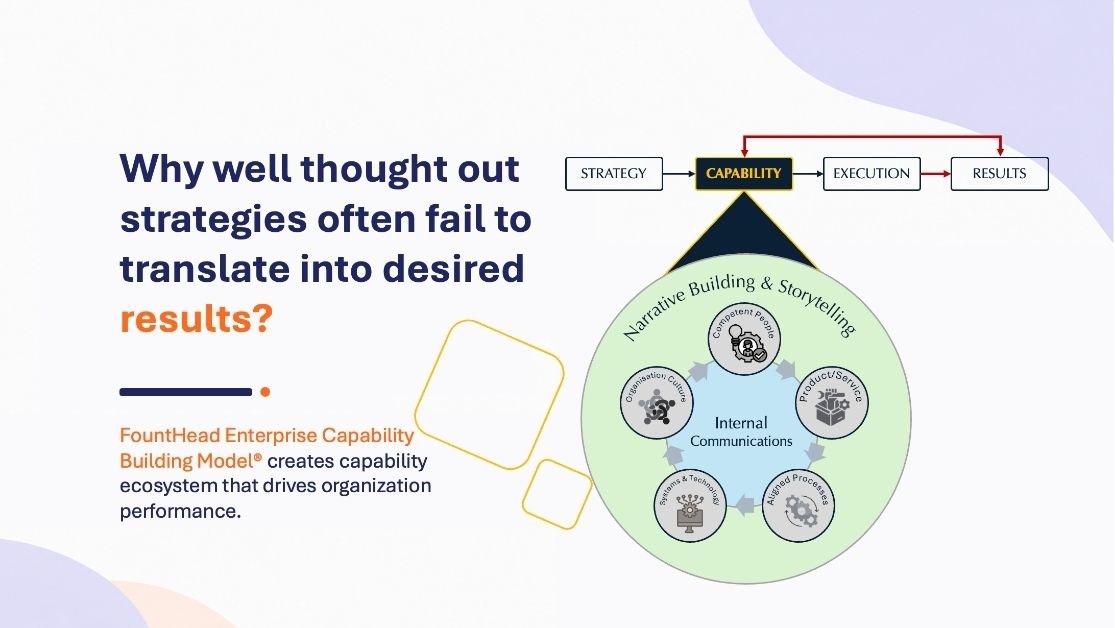
Why Strategy and Execution Are No Longer Enough
FountHead Enterprise Capability Building Model®
Executive Summary
For decades, the dominant language of business leadership has revolved around two ideas:
Strategy and execution.
Boards debate strategy. CEOs communicate strategic priorities. Leadership teams review execution. Business reviews measure results.
Yet between strategy and execution lies a question that is often insufficiently examined: Is the organisation truly capable of delivering its strategy?
This may be one of the defining leadership challenges of our time. Organisations today operate in an environment shaped by technological disruption, rapidly changing customer expectations, new business models, talent volatility and increasing competitive pressure. Strategies that once remained relevant for years may now need to evolve within months. Technologies are transforming jobs faster than organisations can redesign them. Artificial intelligence is changing how decisions are made, how work is performed and what competencies employees require.
In this environment, strategy and execution alone are not enough. Organisations can only execute what they are capable of executing.
The FountHead Enterprise Capability Building Model® places enterprise capability at the centre of the business performance equation:
STRATEGY → CAPABILITY → EXECUTION → RESULTS
- Strategy identifies the opportunity.
- Capability determines how much of that opportunity can actually be realised.
- Execution converts capability into action.
- Results are the outcome.
This paper argues that organisations need to elevate capability from a fragmented functional responsibility to a central leadership agenda. It also argues that Learning & Development, while essential, cannot independently solve the enterprise capability challenge. The future belongs not merely to organisations with superior strategies. It belongs to organisations with the capability to continuously translate strategy into reality.
1. The Great Leadership Imbalance
Leadership attention is a scarce resource. What leaders repeatedly discuss becomes important. What they measure gets managed. What they prioritise receives investment.
In most organisations, leadership attention is heavily concentrated on two ends of the performance spectrum with Strategy at one end and execution on the other.
But there is often far less structured discussion around the space between the two.
That space is: Enterprise Capability
Here lies a fundamental leadership imbalance.
Organisations spend enormous intellectual energy defining what they want to achieve and enormous managerial energy monitoring whether it is being achieved. But they often spend insufficient attention understanding whether the organisation possesses the integrated capability required to make it happen.
This creates a familiar organisational experience:
- A new strategy is announced.
- A transformation office may be created.
- Technology investments are approved.
- Employees are trained.
- Targets are cascaded.
- Dashboards are built.
And yet, performance struggles. The problem is often described as an execution issue. But execution may not actually be the root problem. The deeper problem may be that the organisation never built the capability required for execution in the first place.
Many execution problems are actually capability problems in disguise.
2. Strategy Without Capability Is Mere Aspiration
Every organisation has ambitions. Growth ambitions. Digital ambitions. AI ambitions. Customer experience ambitions. Innovation ambitions. Market leadership ambitions.
But Ambition does not equal capability.
A company can decide to become customer-centric. That does not mean its people know how to serve customers differently.
A company can announce an AI strategy. That does not mean managers understand where AI should be deployed.
A company can decide to become agile. That does not mean its processes, structures and culture support agility.
A company can invest in new technology. That does not mean the technology will create business value.
This distinction is critical.
Strategy asks: What do we want to achieve?
Capability asks: Are we capable of achieving it?
This is why the FountHead Capability Building Model® places capability between strategy and execution:
- Strategy creates intent.
- Capability creates possibility.
- Execution creates action.
- Results create evidence.
Without capability Strategy remains aspiration.
3. Introducing the FountHead Capability Building Model®
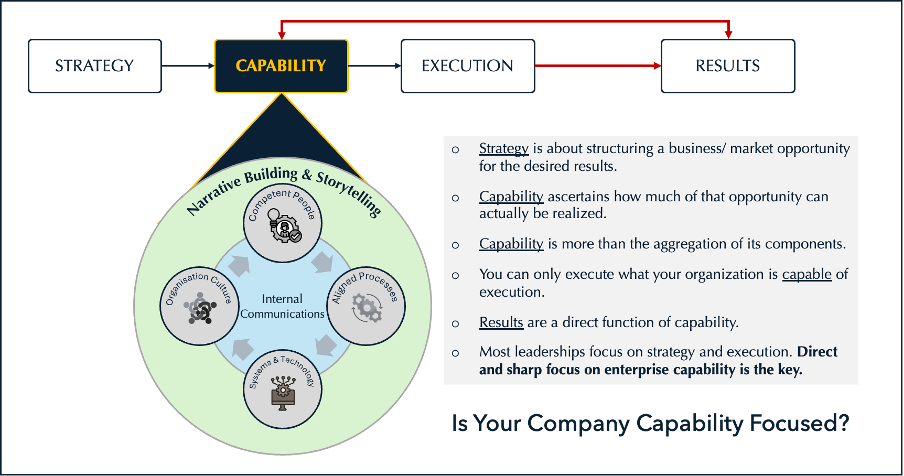
The FountHead Capability Building Model® is based on a simple but powerful premise:
STRATEGY → CAPABILITY → EXECUTION → RESULTS
The model recognises that capability is the critical bridge between strategic opportunity and business performance.
Enterprise capability is built through the integration of four foundational dimensions:
A. Competent People
B. Aligned Processes
C. Systems & Technology
D. Organisational Culture
A. Competent People
People remain central to organisational performance. Organisations require employees who possess the knowledge, skills and behaviours needed to perform effectively. But competence must be directly linked to business strategy.
The critical question is: Are our employees competent to deliver on our business strategy?
Competence without strategic relevance does not automatically create organisational capability.
B. Aligned Processes
People perform through processes. A highly competent employee working within a poorly designed process will struggle to deliver superior results. Processes must therefore be aligned with strategic priorities.
For example:
- If the strategy requires agility but processes require multiple approvals, the organisation has a capability contradiction.
- If the strategy requires customer-centricity but internal processes prioritise departmental convenience, the organisation has a capability contradiction.
Processes are not merely operational mechanisms. They are capability enablers.
C. Systems & Technology
Technology increasingly determines what organisations can and cannot do. But technology alone does not create capability.
A sophisticated system with poor adoption creates little value. Technology must be integrated with people and processes.
Technology becomes capability only when it changes organisational performance.
D. Organisational Culture
Culture determines how an organisation behaves. It influences how people:
- Make decisions
- Respond to failure
- Collaborate
- Take ownership
- Challenge existing practices
- Adapt to change
A strategy requiring innovation cannot succeed in a culture dominated by fear.
A strategy requiring agility cannot succeed where decision-making is excessively hierarchical.
A strategy requiring collaboration cannot flourish in functional silos.
Culture is therefore not simply a soft concept. It is an operational force that can accelerate capability—or silently destroy it.
4. The Fragmentation of Capability
One of the reasons enterprise capability receives inadequate attention is that its components are often dispersed across the organisation. Different functions own different pieces of the puzzle:
- HR may own talent.
- L&D may own competency development.
- Operations may own processes.
- IT may own technology.
- Leadership may discuss culture.
- Business leaders own targets.
Each function may perform effectively. Yet the organisation may still be incapable of delivering a strategic priority.
Why?
Because capability is not the sum of isolated functional excellence.
An organisation may have:
- Excellent people but poor processes.
- Sophisticated technology that employees do not use effectively.
- Strong processes but a culture that discourages initiative.
- A compelling strategy but poor organisational alignment.
- Extensive training but no change in business performance.
Organisational capability is an integrated system. The system performs effectively only when its critical components reinforce one another.
The FountHead Capability Building Model® therefore challenges organisations to ask a deeper question:
How do we integrate the capabilities distributed across the enterprise to deliver strategic outcomes?
5. Capability Is More Than the Aggregation of Its Components
The most important insight within the FountHead Capability Building Model® is that capability is more than the aggregation of its components.
- Competent people do not automatically create capability.
- Technology does not automatically create capability.
- Processes do not automatically create capability.
- Culture does not automatically create capability.
True enterprise capability emerges when these dimensions are aligned towards a common strategic outcome. If one dimension fails, the entire capability weakens.
This is why organisations must stop viewing capability as a collection of independent initiatives.
Capability must be designed as a system—or, more accurately, as an ecosystem.
6. Why Learning & Development Cannot Carry the Capability Agenda Alone
When organisations identify a performance gap, one of the most common responses is:
“We need training.”
Training is important.
Learning is essential.
Competence matters.
But training cannot solve every performance problem.
Consider a sales organisation struggling to improve conversion rates. The immediate response may be to conduct sales training covering:
- Prospecting
- Consultative selling
- Objection handling
- Negotiation
- Relationship management
The programme may receive excellent participant feedback. Employees may score well on assessments. But sales performance may remain unchanged. Why?
Because the problem may not have been a competence problem alone. Perhaps:
- The CRM does not provide useful customer information.
- The approval process is too slow.
- Pricing decisions require multiple levels of authorisation.
- Sales managers do not coach their teams.
- Marketing is not generating quality leads.
- Incentives reward volume rather than customer quality.
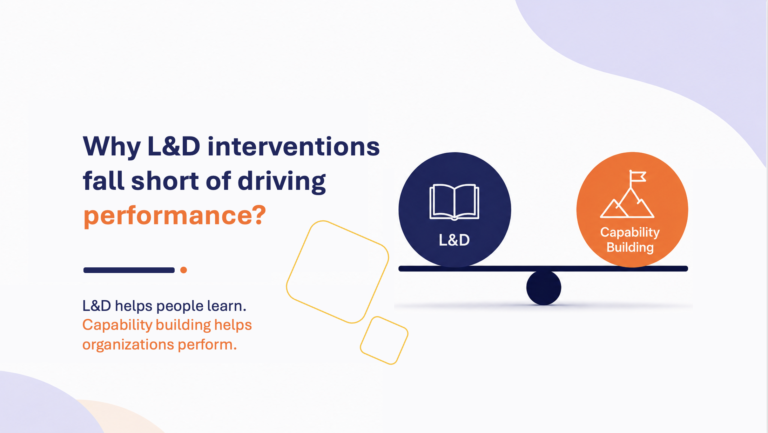
Training cannot compensate for a dysfunctional performance ecosystem. This does not mean L&D is less important. It means L&D needs to become part of a larger capability architecture.
The question must shift from:
“What training do people need?”
to:
“What enterprise capability must we build to achieve the desired business outcome?”
7. From Functional Excellence to Enterprise Capability
Organisations have traditionally pursued functional excellence:
- Excellent HR
- Excellent IT
- Excellent Operations
- Excellent L&D
- Excellent Finance
Functional excellence remains important. But future business success increasingly requires enterprise-level capability integration.
Customers do not experience organisational functions. They experience the organisation as a whole.
Strategies do not succeed within departments. They succeed across the enterprise.
The most important capabilities today—and increasingly in the future—will be cross-functional. Examples include:
- Customer experience
- Digital transformation
- Innovation
- AI adoption
- Sustainability
- Consultative selling
- Operational agility
None of these can be owned by one function alone. They require enterprise orchestration.
And enterprise orchestration requires leadership to create a new capability orientation and ecosystem.
8. The New Leadership Question
Leadership teams traditionally ask:
- Is the strategy right?
- Are we executing effectively?
- Are we achieving results?
The FountHead Capability Building Model® introduces a critical question between these:
Do we possess the capability required to execute our strategy?
This question should become a regular part of strategic and business reviews.
For every major strategic priority, leadership should ask:
- What capability is required?
- What components create that capability?
- Where are the gaps?
- What initiatives could raise our capability as a whole?
These questions transform capability from an abstract concept into a management discipline.
A discipline that is essential for producing the desired strategic business outcomes.
9. Capability as the Ultimate Competitive Advantage
In the past, competitive advantage was often associated with:
- Products
- Technology
- Capital
- Distribution
- Intellectual property
These remain important. But many of these advantages are becoming easier to replicate.
Technology can be purchased. Products can be copied. Strategies can be studied. Capital can be raised.
What is much harder to replicate is an organisation’s deeply embedded capability to perform. Because capability is not one thing. It is a combination. An integration. An alignment. It is forged through patience, perseverance and deliberate design.
Its impact may appear across the organisation in different forms:
- Learning
- Agility
- Collaboration
- Innovation and market disruption
- Process improvement
- The ability to absorb new technologies
Enterprise capability is the organisational equivalent of muscle. A strong organisation is not merely one that performs well today. It is one that can develop the strength required to perform well tomorrow.
10. Conclusion: The Capability Imperative
Business is entering an era in which the speed of change is testing organisations at every level.
- Strategies will need to evolve faster.
- Technologies will disrupt more jobs.
- Customer expectations will continue to rise.
- Business models will continue to change.
In such an environment, organisations cannot rely solely on strategy and execution discipline. They must consciously build the capability to:
Adapt. Perform. Transform.
The FountHead Capability Building Model® offers a framework for this challenge:
STRATEGY → CAPABILITY → EXECUTION → RESULTS
At the centre sits Capability, integrating:
- Competent People
- Aligned Processes
- Systems & Technology
- Organisational Culture
When these dimensions work in isolation, organisations create fragmented improvement. When they work together organisations create enterprise capability.
The leadership imperative is therefore clear. Stop treating capability as something that happens automatically when HR trains people; IT installs systems and Operations improves processes.
Capability must be consciously designed, integrated. governed and directly connected to strategy.
The organisations that thrive in the future will not necessarily be those with the most ambitious strategies. They will be those with the greatest ability to turn ambition into reality.
The FountHead Capability Building Model® positions enterprise capability as the critical bridge between strategy and execution. It is designed to help leadership teams move from fragmented capability initiatives towards a more integrated enterprise approach—connecting strategic priorities with the organisational capabilities required to deliver them.
The FountHead Capability Building Model®
STRATEGY → CAPABILITY → EXECUTION → RESULTS
Strategy identifies where the organisation wants to go.
Capability determines whether the organisation can get there.
Execution turns capability into action.
Results provide the evidence.
Because strategy without capability is aspiration.
And execution without capability will always have limits.
The real leadership question is no longer simply:
Do we have the right strategy?
or:
Are we executing effectively?
It is:
Do we have the capability to turn our strategy into reality?
© FountHead, 2026. All rights reserved.
Turning training into measurable business outcomes?
That is the problem we solve. Let's talk about the capability your strategy actually needs.
Book a Discovery Call