
The human mind is constantly at work.
Even when we are not consciously thinking about something, our minds are observing, interpreting and making sense of the world around us. Every experience we have becomes a piece of information that our minds use to construct meaning. A conversation with a colleague in a break, a decision by a manager, a change in strategy, a promotion, a missed deadline or even a passing comment can become part of a story we create about what is happening around us.
We don’t simply experience events. We interpret them.
And from these interpretations, narratives emerge. These narratives may be about ourselves, about other people, or about the environment in which we operate. Over time, repeated experiences reinforce these stories, making them increasingly influential in how we perceive and respond to the world.
This is a natural and continuous human phenomenon. It happens with or without deliberate stimulus. The same thing happens inside organisations.
Every Organisation Has a Story
An organisation is not a single mind. It is a collection of people, each with their own experiences, perspectives, expectations and assumptions. When something happens in an organisation, therefore, it can generate multiple interpretations.
Leadership announces a restructuring. One employee sees it as an opportunity to become more agile. Another sees it as a sign of instability. A third thinks it is primarily a cost-cutting exercise.
A new technology is introduced. One person sees investment in the future. Another sees an unnecessary disruption. Someone else sees a threat to their role.
A leader says, “We want people to take more ownership.” One employee interprets this as empowerment. Another thinks:
“They are going to give us more responsibility without giving us more authority.”
The event is the same. The narratives are different. And this matters because people don’t act on events alone. They act on the meaning they assign to those events.
When these individual interpretations accumulate and spread, they can become powerful informal narratives within an organisation.
“That’s not how things really work here.”
“Management doesn’t actually listen.”
“It’s safer to wait for approval.”
“Only certain people get opportunities.”
“Every new initiative will eventually disappear.”
“Customer experience matters, but hitting the numbers matters more.”
These stories may never appear in an organisation’s strategy documents. They may not be part of its stated values. Yet they can have a profound influence on behaviour.
When Narratives Work Against Strategy
This becomes particularly important when organisations are trying to execute strategic change.
Imagine an organisation whose strategy requires greater innovation. Its leaders communicate that experimentation is encouraged and that people should be willing to challenge conventional thinking. But employees have experienced mistakes being criticised and unsuccessful experiments being remembered for a long time.
The organisation’s stated narrative is:
“Take risks. Experiment. Learn.”
The lived narrative becomes:
“Don’t make mistakes. Keep your head down.”
Which narrative will determine behaviour? Usually, it is the one people have experienced repeatedly. This is why a gap between organisational strategy and internal narrative can become a significant barrier to execution.
An organisation may invest heavily in developing new skills, introducing new processes and communicating new strategic priorities. Yet if the stories people tell themselves about the organisation contradict those priorities, the desired behaviours may never become embedded.
The organisation is, in effect, trying to move in one direction while its internal narrative pulls people in another.
Organisations Cannot Operate Without an Internal Narrative
An organisation cannot choose whether it has an internal narrative. It can only choose whether to shape it deliberately.
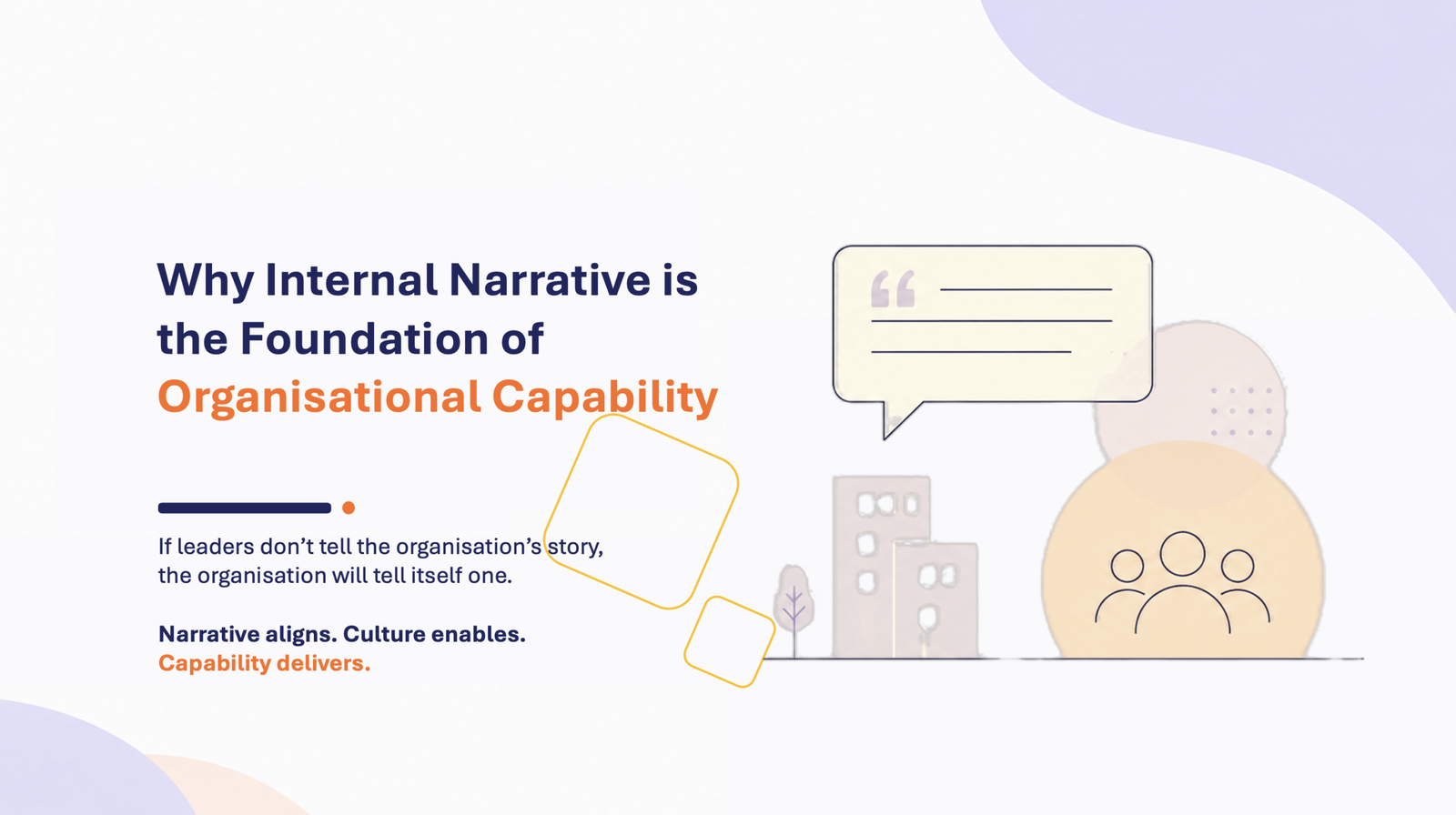
There will always be stories. If leaders don’t tell the organisation’s story, the organisation will tell itself one. When there is a vacuum of information or meaning, people naturally fill it.
This doesn’t mean leaders should attempt to control every conversation or manufacture a single version of reality. Nor does it mean that internal communication should become corporate propaganda. Quite the opposite.
A strong internal narrative needs to be credible, coherent and connected to people’s lived experience. It should help employees understand:
- Who are we?
- Where are we going?
- Why does it matter?
- What do we believe?
- What does this mean for me?
- What behaviours will help us succeed?
- What does “good” look like here?
When these questions are answered consistently, people have a framework through which to interpret what happens around them. The organisation begins to create a shared understanding of what matters and how we work.
Internal Narrative Is the Foundation of Capability Building
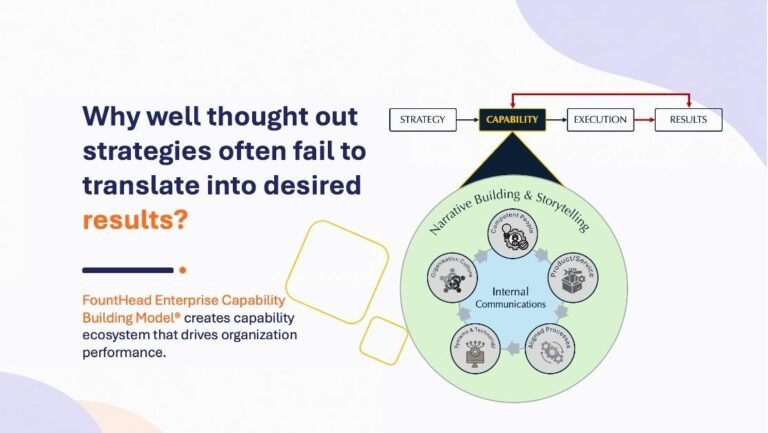
The FountHead Enterprise Capability Building Model®, created by FountHead Learning, is a distilled insight of two decades of experience helping clients create organisation capability. The model is being implemented in large marquee organisations today for their capability building. Internal narrative sits at its foundation.
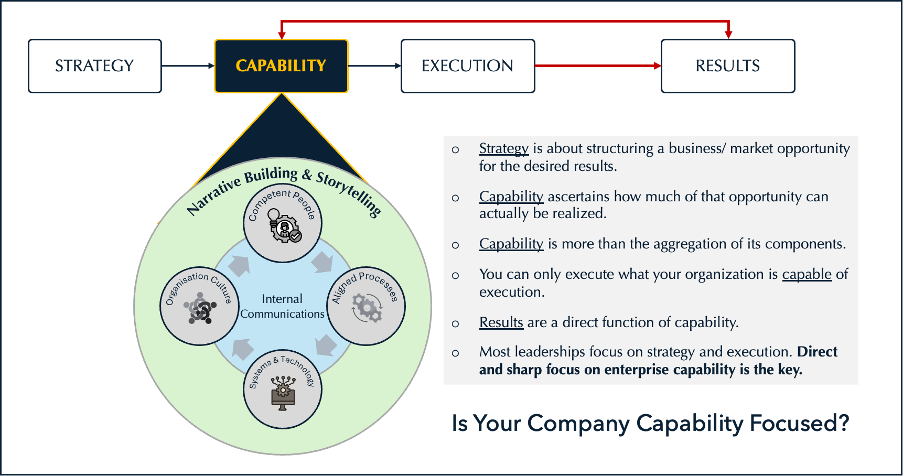
Read more about FountHead Enterprise Capability Building Model®
The model highlights that capability is more than the aggregation of its components – i.e. competent people, product/services, aligned processes, supportive systems and culture. A well-researched, carefully designed, credible and coherent internal narrative is the guiding force that provides clear direction and purpose for each of these components.
Consider an organisation seeking to build the capability for customer-centricity. It actively promotes the narrative:
“Every decision we make should begin with an understanding of the customer problem we are trying to solve.”
Now, the organisation can train people in customer research, service design and problem-solving. But capability becomes much more powerful when each component shares the narrative.
As a result:
- The product development team creates an offering that understands and solves real customer problems.
- The service processes are designed to provide a distinctive customer experience.
- There are systems that track customer satisfaction scores in real time.
- Leaders drive a customer-first culture by routinely sharing customer success stories and celebrating actions and behaviours that create those stories.
The model argues that capability is not simply about whether people, processes and technology can do something. It is also about whether they understand and reflect why it matters, how it connects to the organisation’s purpose and strategy.
Conclusion: Making Narrative the Foundation of Capability
Organisations cannot afford to leave their internal narrative to chance. The stories people create from their experiences can either reinforce strategic intent or quietly work against it. This is why, at FountHead, we see internal narrative not as a communication exercise, but as a fundamental element of enterprise capability.
The FountHead Enterprise Capability Building Model® places internal narrative at its foundation because capability is created when people, processes, products and services, systems and culture are aligned around a shared sense of purpose and direction. A credible and coherent narrative gives these components a common meaning and connects everyday actions to organisational strategy.
But a narrative becomes powerful only when it is continuously brought to life. Storytelling is the foundation, while internal communication is the lifeblood that keeps the narrative alive across the organisation.
Ultimately, building capability is about more than enabling an organisation to do something. It is about creating a shared understanding of why it matters, what it means, and how everyone contributes to making it happen.
Turning training into measurable business outcomes?
That is the problem we solve. Let's talk about the capability your strategy actually needs.
Book a Discovery Call