
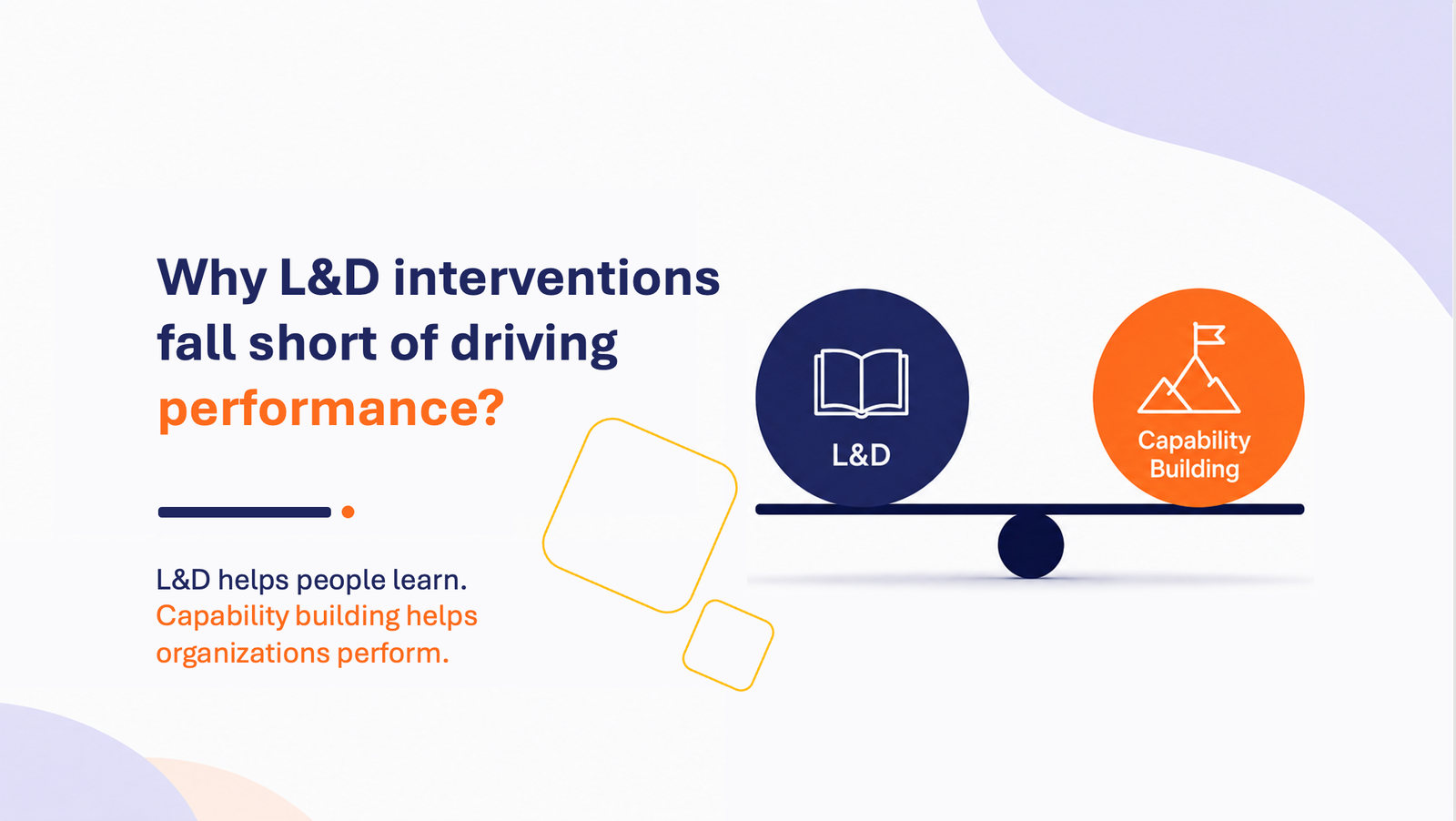
L&D helps people learn. Capability building helps organisations perform.
The distinction may sound subtle, but it changes how organisations think about learning, transformation and business performance.
For years, organisations have approached Learning & Development (L&D) by asking:
- What skills do our people need?
- What training programmes should we run?
- How many employees need to be trained?
- How many learning hours should we deliver?
These are important questions. But when an organisation is trying to transform its business, a more fundamental question needs to be asked:
What must our people be capable of doing differently for the business to achieve its strategic objectives?
That is where the conversation moves from Learning & Development to capability building.
What Is Learning & Development?
Learning & Development is the organisational function responsible for enabling people to acquire knowledge, skills and behaviours that support their roles and development.
It can include:
- Technical training
- Leadership development
- Sales training
- Behavioural programmes
- Onboarding
- Coaching
- Digital learning
- Career development
- Compliance and mandatory learning
L&D plays a critical role in helping people learn and grow. But learning is not the same as performance.
An employee can complete a programme, pass an assessment and demonstrate that they understand a concept—without necessarily applying it effectively in the workplace.
This is where capability building becomes important.
What Is Capability Building?
Capability building is the systematic development of the knowledge, skills, behaviours, decision-making abilities and organisational conditions required to achieve specific business outcomes.
Capability is therefore broader than learning.
It asks not only:
“What do people need to know?”
but also:
“What must they be able to do, consistently and in context, for the business to succeed?”
This distinction is fundamental.
Think of L&D as the engine. Capability building is the entire vehicle.
An engine is essential to a vehicle. But an engine alone doesn’t get you to your destination.
You also need a vehicle designed for the journey, a capable driver, a route, fuel, navigation and conditions that allow the vehicle to move.
L&D is similar. It develops the knowledge and skills that people need.
Capability building connects those skills with:
Business context + Behaviour + Leadership + Systems + Practice + Reinforcement + Measurement
The objective is not simply to make people more knowledgeable.
It is to make the organisation more capable of executing its strategy.
L&D vs Capability Building: What’s the Difference?
| L&D | Capability Building |
|---|---|
| Starts with learning needs | Starts with business priorities |
| Focuses primarily on knowledge & skills | Integrates knowledge, skills, behaviours and context |
| Often programme-oriented | Designed as an ongoing capability journey |
| Asks what people need to learn | Asks what people need to be able to do |
| Measures learning activity and outcomes | Measures application, behaviour and business outcomes |
| Training is often the primary intervention | Learning is one component of a broader solution |
| Can be led primarily by L&D | Requires business, HR, L&D and leadership involvement |
| Can address an immediate skill gap | Builds capabilities required for sustained performance |
The point is not that L&D is wrong.
It is that L&D is one component of capability building.
The Shift From Learning to Performance
Consider a bank that wants its relationship managers to increase customer wallet share.
An L&D approach might identify gaps in:
- Product knowledge
- Consultative selling
- Communication
- Relationship management
It may then create a training programme around these areas.
But a capability-building approach begins with a different question:
What is preventing relationship managers from deepening customer relationships and increasing wallet share?
The answer may have little to do with product knowledge.
Perhaps relationship managers:
- Struggle to identify deeper customer needs
- Rely on transactional conversations
- Lack confidence in making recommendations
- Receive limited coaching from managers
- Are measured primarily on short-term transactions
- Have insufficient opportunities to practise new behaviours
Now the solution cannot be a classroom programme alone.
It requires a broader capability-building ecosystem involving:
Learning + Application + Coaching + Leadership + Performance Measures + Reinforcement
That is the difference between training for knowledge and building capability for performance.
Why Does This Distinction Matter in India?
Indian organisations are navigating rapid transformation across sectors—from BFSI and manufacturing to luxury retail, QSR, mining and hospitality.
Technology is changing jobs.
Customer expectations are changing.
Business models are evolving.
Organisations are asking employees to adopt new tools, make faster decisions and work in fundamentally different ways.
The challenge is therefore not simply whether employees can learn something new.
It is whether they can apply it consistently in the context of the business.
The World Economic Forum Future of Jobs Report 2025 identifies skills gaps as the top barrier to business transformation, with 63% of employers surveyed globally citing them as a major barrier.
Deloitte’s 2025 India research also highlights the importance employees place on learning through work: 94% of Indian Gen Z professionals and 97% of Indian millennials surveyed considered on-the-job learning valuable for career growth.
The message for organisations is important:
People don’t simply need more learning. They need an environment in which learning can become capability.
Capability Is the Bridge Between Strategy and Execution
Imagine an organisation announces:
“We are becoming more customer-centric.”
Training can teach employees customer-service techniques.
But capability building asks:
- Do employees understand what customer-centricity means in their role?
- Can they make decisions from the customer’s perspective?
- Do managers coach and reinforce customer-centric behaviours?
- Do processes support the desired experience?
- Do performance measures reward the right behaviours?
- Do leaders model the change?
- Can the organisation measure whether customer behaviour and outcomes are actually changing?
The strategy may be clear.
The training may be excellent.
But without capability, there is still a gap between strategy and execution.
A recipe doesn’t make someone a chef.
Likewise, a training programme doesn’t automatically create organisational capability.
Does Capability Building Make L&D Less Important?
No. It makes L&D more strategic.
The future of L&D is not about becoming less relevant.
It is about moving closer to the business instead of being measured primarily by:
- Number of programmes delivered
- Attendance
- Completion rates
- Learning hours
- Participant satisfaction
L&D can increasingly ask:
- What business problem are we solving?
- Which capabilities are critical to solving it?
- What behaviours need to change?
- What will enable people to apply the learning?
- How will managers reinforce it?
- How will we know whether performance has improved?
This changes the role of L&D from programme provider to capability partner.
When Does an Organisation Need Capability Building Rather Than Training?
Training may be sufficient when the challenge is a clearly defined knowledge or skill gap.
Capability building becomes more important when:
- A business strategy requires new ways of working
- Transformation involves multiple roles or functions
- Behaviour needs to change
- New technology or processes are being adopted
- Leadership needs to reinforce new ways of working
- Existing systems or incentives may prevent application
- The organisation needs sustained performance improvement
In simple terms:
If the problem is “people don’t know how,” training may help.
But if the problem is “the organisation needs people to consistently perform differently,” capability building is the larger answer.
How Should Organisations Measure Capability Building?
Capability cannot be measured through learning completion alone.
Measurement should connect the capability journey to the business objective.
Depending on the context, this could include:
1. Learning indicators
What did people learn?
2. Application indicators
Are they applying it?
3. Behaviour indicators
Are they behaving differently?
4. Performance indicators
Is individual or team performance improving?
5. Business indicators
Is the organisation achieving the intended business outcome?
For example, a sales capability programme may ultimately need to connect learning and behavioural changes to indicators such as conversion, productivity, customer retention or revenue—not simply attendance and assessment scores.
The further measurement moves from:
“Did they attend?”
to:
“Did the business improve?”
the more meaningful it becomes.
So, What Should Organisations Do Differently?
Instead of starting with:
“What training do our people need?”
start with:
“What business outcome are we trying to achieve?”
Then work backwards:
Business outcome
↓
Required capabilities
↓
Behavioural shifts
↓
Barriers to performance
↓
Learning & enablement
↓
Practice and reinforcement
↓
Measurement
This is capability building.
The FountHead Perspective
At FountHead, we believe learning should not be the destination.
It should be the bridge between business intent and business performance.
We don’t believe organisations transform simply because their people know more.
They transform when their people can do what the business needs them to do—consistently, confidently and in context.
That is why we start with business priorities rather than learning calendars.
We identify the capabilities required to achieve those priorities and design interventions that bring together:
Learning + Context + Behaviour + Leadership + Reinforcement + Measurement
Because ultimately:
L&D builds learning.
Capability building builds the ability to turn learning into performance.
And in a world where business strategy, technology and customer expectations are changing faster than ever, that distinction matters.
The future isn’t about training more. It’s about building the capabilities that matter.
Frequently Asked Questions
What is the difference between L&D and capability building?
L&D primarily focuses on developing employee knowledge, skills and behaviours through learning interventions. Capability building is broader. It connects learning with business context, behaviour, leadership, systems, reinforcement and measurement to enable sustained business performance.
Is capability building the same as training?
No. Training is one component of capability building. Training can develop knowledge and skills, while capability building focuses on enabling people to apply those skills consistently in the context of their roles and business objectives.
Why is capability building important for business transformation?
Business transformation often requires people to work, decide and behave differently. Capability building develops the knowledge, skills, behaviours and organisational conditions required to make those changes sustainable.
Can L&D become a capability-building function?
Yes. L&D can evolve from primarily delivering learning programmes to helping the business identify critical capabilities, enable application, support behavioural change and measure business impact.
Why doesn’t training always create capability?
Training may not translate into capability when employees lack opportunities to practise new skills, managers do not reinforce new behaviours, organisational systems encourage old behaviours, or the learning is disconnected from real business challenges.
How do you measure capability building?
Capability building can be measured across learning, application, behaviour, performance and business outcomes. The relevant measures depend on the strategic objective being addressed.
What role do managers play in capability building?
Managers create the environment in which learning becomes practice. Through coaching, feedback, opportunities to apply new skills and reinforcement, managers play a critical role in converting learning into sustained capability.
Who owns capability building in an organisation?
Capability building cannot sit entirely with L&D. It requires collaboration between business leaders, HR, L&D, managers and employees because capability is ultimately demonstrated through business performance.
What are examples of organisational capabilities?
Examples include:
- Consultative selling
- Customer-centricity
- Digital adoption
- Innovation
- Strategic leadership
- Frontline decision-making
- Operational excellence
- Risk management
- Data-driven decision-making
How does FountHead approach capability building?
FountHead starts with business priorities rather than training requirements. We identify the capabilities required to achieve those priorities and design interventions that connect learning with business context, behavioural change, leadership, reinforcement and measurable business outcomes.
What is the simplest way to explain L&D versus capability building?
L&D helps people learn what they need to know.
Capability building helps people consistently do what the business needs them to do.
Turning training into measurable business outcomes?
That is the problem we solve. Let's talk about the capability your strategy actually needs.
Book a Discovery Call