
Why Effective Large Frontline Workforce Training Is a Structural Challenge in India
An Enterprise Capability-Building Perspective
KNOWLEDGE PAPER
Capability Building • Strategic Training • Measurable Business Outcomes
Executive Summary
Large frontline workforces are the operational backbone of India’s retail, BFSI, manufacturing, pharma, mining and hospitality sectors — and also enterprises’ single biggest capability-building headache.
Despite sustained investment in classroom training, LMS-tracked e-learning and supervisor coaching, the pattern repeats across industries: mediocre product knowledge, inconsistent selling and service quality, and productivity that never quite catches up with the investment made.
This paper argues that the root cause is not effort, budget or intent — it is a structural design mismatch.
Almost every training methodology used by Indian enterprises is derived from L&D research and program design developed in mature, western labour markets, where the gap between what a fresher already knows and what the market demands — △X — is narrow enough to be closed by a reasonably short, well-designed program.
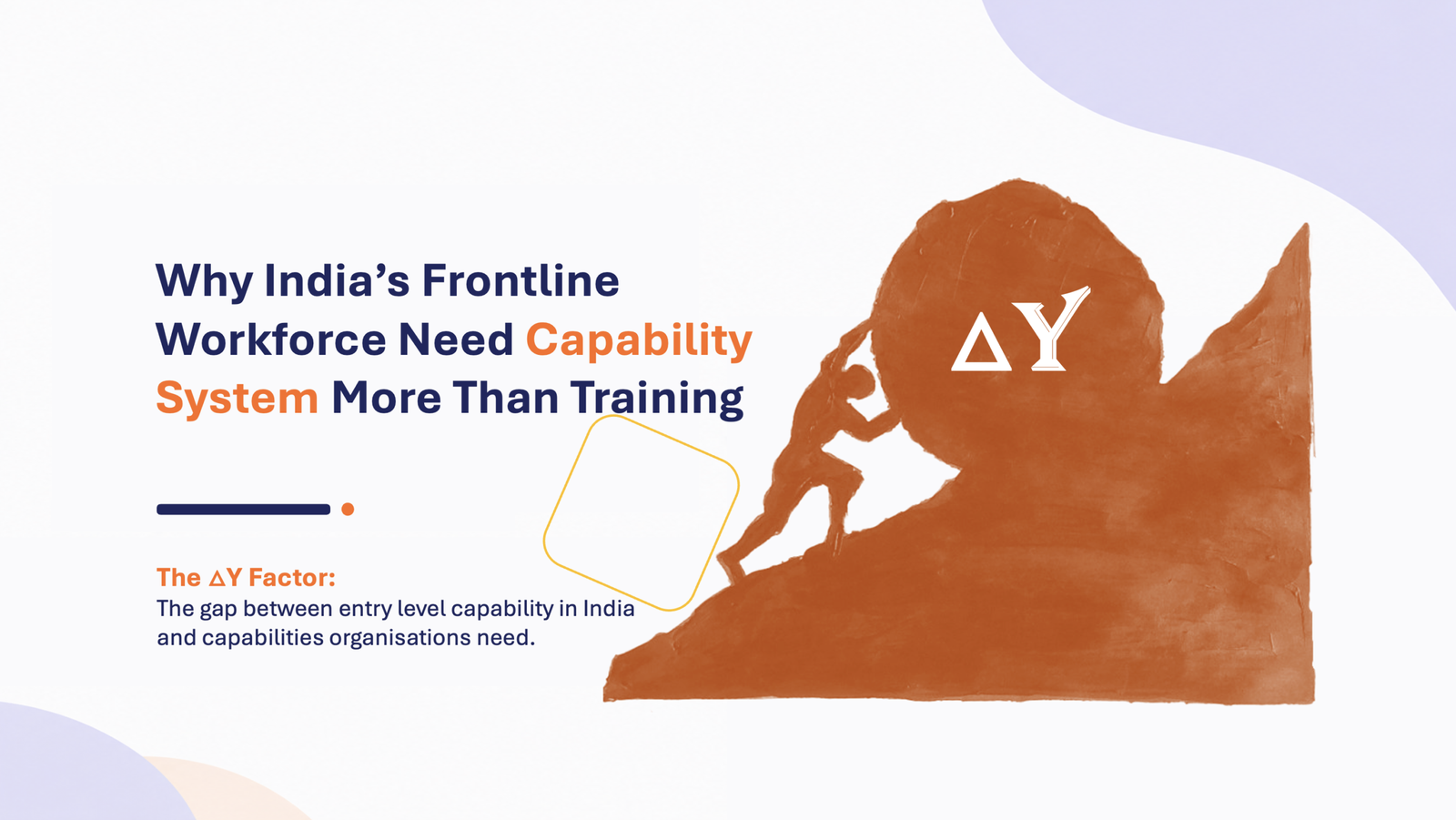
In India, the equivalent entry-level gap — which this paper calls △Y — is far larger, and is rooted chiefly in the quality of elementary education and in socio-economic context, not in flaws of program design.
When enterprises apply △X-designed programs to a △Y-sized gap, they get one of two failure modes:
- Programs that are effective but prohibitively long and expensive.
- Programs that are affordable but structurally unable to close the gap.
Recognising △Y as a distinct, measurable phenomenon — rather than a training-quality problem — is the starting point for building frontline capability at enterprise scale in India.
A Scenario
Consider a lifestyle retail company employing 25,000 frontline salespeople across its stores all over India.
The company has a wide, technologically superior product range. Its salespeople are mostly freshers or have 1–2 years of experience, are 12th-pass or graduates from tier 2–3 towns and come largely from modest socio-economic backgrounds.
The average salary of a salesperson is approximately ₹20,000 per month, and attrition runs as high as 60% a year.
The company understands the value of effective training as central to its business objectives and has engaged a reputed training agency.
The agency conducts classroom training across regions three times a year on product knowledge, selling skills and customer engagement, supported by online learning material on the company’s LMS, with completion tightly monitored. Sales supervisors are also encouraged — and measured on their KPIs — to develop their teams.
And yet:
- Sales productivity remains sub-optimal.
- Product knowledge is dodgy.
- The quality of customer interactions is poor.
- All of the above are compounded by high attrition: new hiring is a continuous, year-long process, and many newcomers go without any training for as much as a couple of months after joining.
The CEO’s recurring question — tinged with exasperation — is: Why are we not getting the business results we want when we are trying everything and investing so much in training? What are we missing?
An India-Wide Problem
If this scenario sounds familiar, it is not restricted to retail.
It plays out, in different shades, across pharma — medical representatives; manufacturing and engineering; financial services — mutual fund advisors, insurance agents and retail banking staff; travel and tourism; hospitality; healthcare; mining; utilities and more.
This has also been the story of skill development in India as a whole.
The National Skill Development Corporation (NSDC), established in 2008 along with 37 Sector Skills Councils, was a national-level strategic initiative aimed at transforming India’s skill landscape. The effort expanded with the creation of the Ministry of Skill Development & Entrepreneurship in 2014 and the launch of the National Skill Development Mission in 2015.
Many schemes and programs have followed, in earnest.
Yet beyond the data, lived experience across industries tells a different story: people entering the job market are frequently poorly equipped with the professional and job skills the market demands.
Companies must therefore invest heavily in training and still struggle to build the skills they need.
With more than half its population young and of working age, India consequently finds itself with a workforce that is inadequately skilled at the point of hire — a serious economic and social concern.
So why, despite considerable intent, effort and investment sustained over so long, do we still fall short of the skill-development outcomes we are aiming for?
Is something fundamental being missed?
What the Wider Evidence Shows
Independent research over the last few years corroborates the pattern described above, and sharpens it in ways directly relevant to frontline hiring.
Graduate employability has improved, but only to just above half
The India Skills Report — an annual study by Wheebox with CII, AICTE and AIU based on the Global Employability Test — has tracked employability rising from around a third of Indian graduates a decade ago to just over half in the most recent editions.
Read the other way, close to half the country’s formally educated graduate pool is still assessed as not fully industry-ready — before any frontline-specific selling, service or compliance skill is even factored in.
The gap is widest exactly where most frontline hiring happens
The same research shows ITI and polytechnic diploma holders — the most common feeder pool for frontline retail, manufacturing and technical roles — with employability well below university graduates, often in the 30–45% range even as overall numbers improve.
Foundational capabilities continue to lag
Independent assessments point to the same story from another angle.
Mercer-Mettl’s Graduate Skill Index finds that while technical proficiency in graduates is improving, foundational capabilities — communication, critical thinking and learning agility — lag well behind.
These are precisely the capabilities frontline sales, service and compliance roles depend on most.
The frontline-as-cost-centre trap is not unique to India
Global research, including McKinsey’s work on frontline operations, confirms that treating frontline workers as a cost line rather than a capability investment depresses performance in any geography.
What is distinct in India is the size of the entry-level gap that any capability program has to close before that investment can even begin to pay off.
Policy-level skilling and enterprise-level capability are different problems
NSDC, the Ministry of Skill Development & Entrepreneurship and the National Skill Development Mission have built substantial scale and infrastructure at the national level.
Yet enterprise-level experience — as in the scenario above — shows the gap persisting at the point of hire.
This is not a comment on policy intent; it simply means enterprises cannot wait for macro-level skilling outcomes to mature before solving their own frontline capability problem.
The △Y Factor: A Model to Decode the Skill Conundrum in India
Every market, depending on its own maturity, demands that the frontline people serving it demonstrate a certain minimum level of skill and competence. Companies must therefore ensure their frontlines have those skills to compete in their respective markets. In most cases, Indian markets have evolved to be at par with global standards in terms of what the market expects.
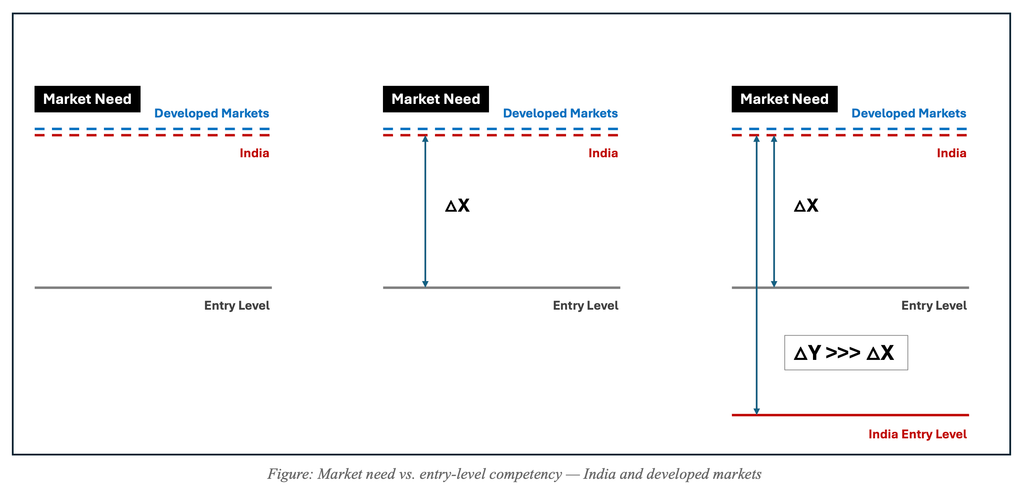
In figure (a) above, the two dotted lines — red for India, blue for developed markets — represent the skill level the market needs or demands. In most cases, Indian markets have evolved to be at par with global standards in terms of what the market expects.
Referring to figure (b): the grey line is the entry-level knowledge or competency that freshers entering the company or industry bring with them. △X — the gap between entry-level competency and the level the industry or market requires — is the gap that any effective training and capability-building program needs to fill.
The extent and nature of this △X gap defines the design of the skill-building intervention: its subject matter, content, pedagogy, methodology and duration. A successful design is one where the cost of the intervention is significantly offset by the business benefit of a competent, skilled frontline workforce.
Modern training and skill-building approaches — most of them developed in western markets (the Americas and Europe) — are built to satisfy this cost–benefit equation. They ensure the △X gap is covered through programs of reasonable length and practical duration.
Figure (c) shows the Indian reality against this backdrop. While the market’s required output-level skills and competencies are nearly the same in both cases, the entry level in India is far lower, and the resulting gap — △Y — is far greater than △X.
The Reasons for the Big △Y
△Y is defined by the entry-level knowledge, competencies and preparedness that need to be upgraded during the training program.
It depends chiefly on two factors.
1. The Quality of Basic Elementary Education
Skills and competencies cannot be built in a vacuum; they need a fundamental grounding to stand on. It is very difficult, for instance, to train someone on advanced carpentry if they don’t know what a right angle is. Poor quality and high inequality in basic elementary education is, perhaps, the single biggest contributor to the △Y problem.
2. Socio-Economic Factors
In many low-income families, the daily struggle for survival pushes children toward early employment and income. Crammed, unclean localities and households with poor civic amenities often erode a sense of aesthetics, propriety and social etiquette. Children burdened by poor education and difficult socio-economic circumstances, on reaching employable age, pose a real challenge for employers — sometimes lacking fundamentals such as:
- Personal hygiene
- The ability to hold a courteous conversation
- Personal integrity
- The ability to follow simple instructions
These factors are often silent but decisive contributors to △Y, deeply rooted and very difficult to shift through limited-duration skill-building programs.
The Implications of △Y >>> △X
This situation — △Y far exceeding △X — has serious implications for the success of skill-building efforts, given that most intervention design models are informed by L&D research and program templates developed in mature markets.
The Economic Cost Problem
If enterprises continue to follow established, western-derived program-design templates, program duration must stretch to cover the △Y gap. This renders programs prohibitively expensive and impractical at scale.
The Ineffectiveness Problem
If duration is kept manageable instead, too much content gets packed into too little time, with little regard for retention, assimilation or practice. The goal quietly shifts to completion and certification. The resulting skills and competencies fall short of what the market demands, and the program fails its core objective of closing △Y — in spite of every right intention, effort and investment.
Conclusions
The △Y framework leads to four conclusions with direct consequences for how enterprises design, budget for and govern frontline capability building in India.
1. The Problem Is Structural, Not Attitudinal
Persistent underperformance of frontline training investment is a design mismatch, not a failure of intent, effort or spend. Enterprises that add training days, raise budgets, or tighten LMS completion tracking within an unchanged program design are, in effect, trying to close a △Y gap with a △X-sized intervention.
The outcome is either an unaffordable program or an ineffective one — rarely both goals met at once.
2. △Y Is Only Partly a Training Problem
A meaningful share of the gap originates upstream, in elementary education quality and socio-economic context, long before a candidate is hired. No training program — however well designed — can retrofit twelve years of schooling or reverse deep socio-economic disadvantage in a two-to-six-week induction cycle.
Enterprises should therefore set realistic expectations for what a single intervention can achieve, and design capability systems that assume a wide, variable entry point rather than a narrow, standard one.
3. Closing the Trainable Part of △Y Requires a Capability System, Not a Training Event
Entry-level readiness varies widely across candidates, regions and cohorts. At the same time, high frontline attrition keeps the induction pipeline permanently open. Effective capability building therefore has to be:
- Continuous
- Embedded in the flow of work
- Reinforced repeatedly
- Measured by on-the-job behaviour
- Connected to business outcomes rather than completion certificates
A training calendar built around two or three classroom cycles a year — however well produced — structurally cannot keep pace with a workforce being replenished every month.
4. △Y Is a Leadership Issue, Not a Vendor Deliverable
Because △Y is a scale-and-design problem rather than a delivery-effort problem, closing it needs to be owned as an enterprise capability-building priority. It needs to be:
- Sponsored at business-leadership level
- Integrated with frontline operations
- Connected to incentive design
- Resourced as a strategic investment
It cannot simply be delegated as a stand-alone L&D or training-vendor line item.
The FountHead Reference Point of View: Enterprise Capability Building at Scale
FountHead’s work with large frontline workforces across retail, BFSI, mining, manufacturing, pharma and hospitality over more than two decades has, in effect, been a sustained encounter with exactly the △Y problem set out in this paper.
Our point of view on enterprise capability building at scale follows directly from that experience.
Capability Is Not Training Completion
We define capability as Capacity plus the ability to produce a consistent, measurable business outcome.
A frontline workforce can be shown as 100% “trained” on LMS records and still fail to close △Y, because completion measures exposure, not capability. Enterprise programs must therefore be designed and governed against business outcomes — such as:
- Sales productivity
- Certification pass rates
- Coverage
- Retention
- Customer experience
— rather than course completion.
Design Must Start From the Actual Entry Point
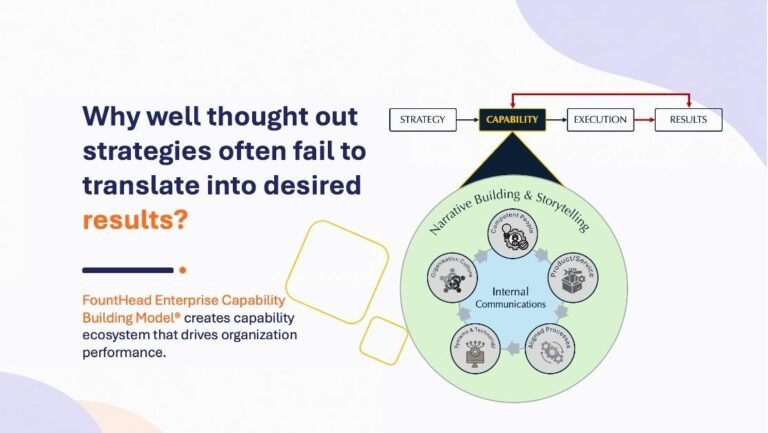
The starting point for capability building cannot be the ideal curriculum. Our process — research & development, narrative building, learning design, content, distribution & delivery, and monitoring & governance — begins by establishing where a specific workforce cohort actually stands: its real △Y.
This is the opposite of taking an off-the-shelf, western-designed training template and simply localising the language.
Narrative and Medium Matter as Much as Content
India’s △Y is not only a knowledge gap; it is also a readiness, confidence and contextual gap. This is why film- and story-led learning — FountHead’s founding methodology — can close gaps that text-and-lecture formats structurally cannot.
It meets learners where their comprehension, attention and cultural context actually are, at a fraction of the cost and time of long-format classroom remediation.
Scale Demands a Different Distribution Logic
Because frontline attrition makes induction a continuous, not periodic, process, capability building at scale needs an “always-on” distribution model rather than fixed classroom cycles.
This means mobile-first, binge-style learning platforms rather than static LMS repositories, combined with hybrid physical-plus-digital delivery for the parts of capability — such as attitude and on-ground coaching — that still need a human touch.
Governance Must Close the Loop Back to Business KPIs
Every engagement should be anchored in outcome metrics agreed with the client at the outset. These might include:
- Higher certification pass rates
- Higher cross-sell or up-sell metrics
- Shorter onboarding turnaround time
- Sustained productivity gains
This is what converts a training initiative into a capability-building investment with demonstrable return.
The Strategic Implication
In the Indian context, “training” and “enterprise capability building at scale” are not the same activity. Treating them as interchangeable is a large part of why the △Y gap persists despite decades of investment.
Capability building at scale must instead be run as a business transformation function:
- Co-owned by business and HR leadership
- Grounded in research-led design
- Delivered through media and distribution models suited to India’s actual entry-level reality
- Governed by business outcomes rather than learning activity
This is FountHead’s core thesis, and the basis on which we partner with enterprises seeking to close their own △Y gap.
References
- National Skill Development Corporation (NSDC) and Sector Skills Councils — established 2008.
- Ministry of Skill Development & Entrepreneurship — established 2014.
- National Skill Development Mission — launched 2015.
- Wheebox, Confederation of Indian Industry (CII), All India Council for Technical Education (AICTE) and Association of Indian Universities (AIU) — India Skills Report, 2025 and 2026 editions, based on the Global Employability Test.
- Mercer-Mettl — India’s Graduate Skill Index, 2025.
- McKinsey & Company — Unlocking frontline workforce stability and productivity in operations, McKinsey Operations Blog.
- FountHead — company approach, solutions (LIFT, Film Based Training Methodology, OLVP, SOAR) and case studies, founthead.com.
Turning training into measurable business outcomes?
That is the problem we solve. Let's talk about the capability your strategy actually needs.
Book a Discovery Call