
Executive Summary
Every large enterprise with a frontline workforce eventually asks the same question:
Why does our training investment keep growing while our business outcomes don’t?
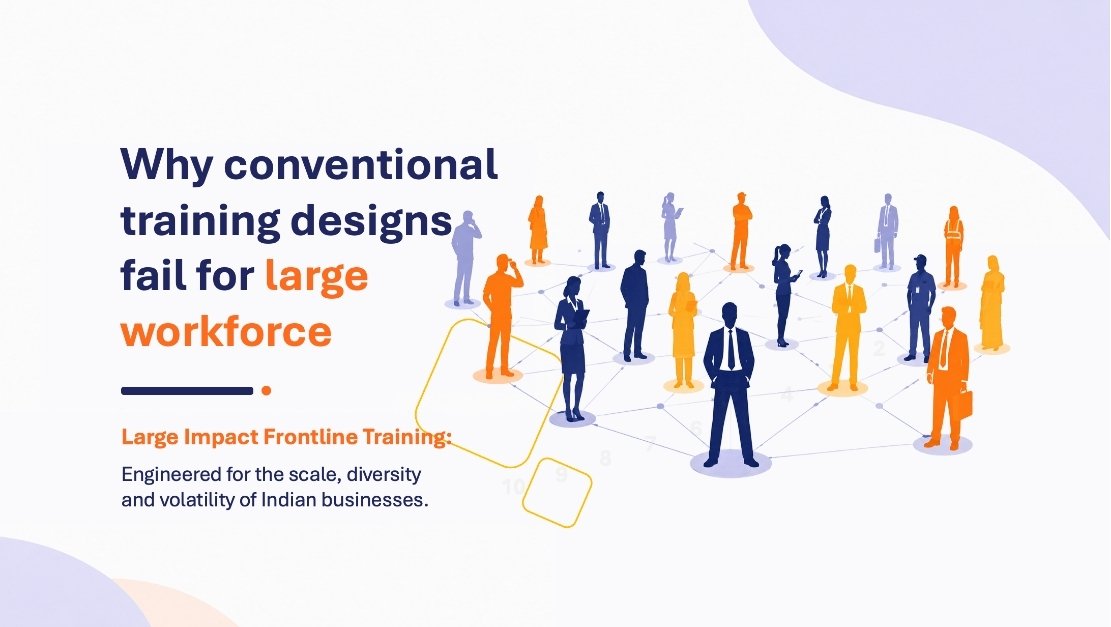
The answer is rarely “not enough training.” The problem is that most training models deployed in India were never engineered for the scale, diversity and volatility of a large frontline workforce. They were designed for smaller, relatively homogeneous audiences. They begin to buckle when applied to 10,000+ employees spread across geographies, languages and literacy levels – and replenished continuously by high annual attrition.
LIFT — Large Impact Frontline Training is FountHead’s answer to this specific challenge. LIFT is built around four elements that conventional training programmes often address separately:
Content + Distribution + Delivery + Governance
This combination is not incidental. At frontline scale, these four elements need to work together as one integrated capability system. This article explains why, how each element works, and the evidence behind the model.
The Scale Problem Nobody’s Training Model Was Built For
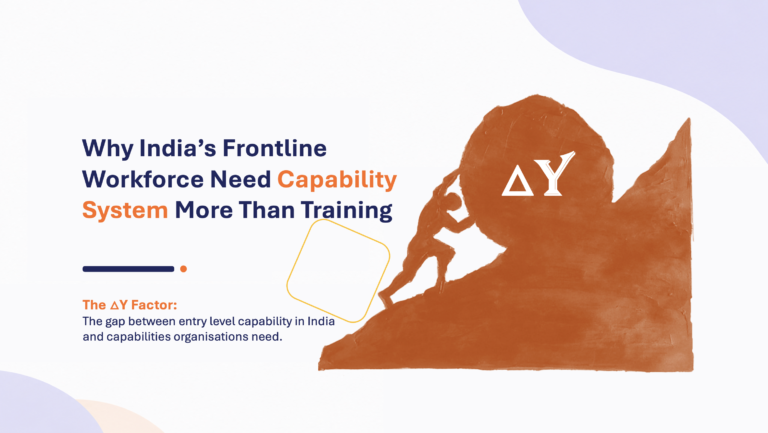
In our knowledge paper on The △Y Factor, we set out why frontline training in India so often under-delivers despite genuine investment and intent.
In India, the entry-level capability gap is structurally larger, rooted in the quality of elementary education and socio-economic context. So, when a business applies a training template built for a smaller △X gap to a workforce with a larger △Y gap, one of two things typically happen:
The programme becomes long and expensive enough to work—or it remains short and affordable but ineffective.
Scale magnifies the problem.
Large frontline workforces can be spread across states, languages and literacy levels, while being continuously replenished through high attrition. This creates a fundamentally different training-design challenge.
Where the Break Happens
1. Content breaks
A single, static curriculum cannot serve a workforce this diverse without becoming either too generic to be useful or too long to be affordable.
2. Distribution breaks
Content may be well designed but pushed through the wrong channel. A purely classroom-based model may not support the scale or connectivity requirements of the workforce. A purely online model may fail where employees do not have reliable access to devices or networks.
3. Delivery breaks
Even when content reaches people, classroom-style facilitation cycles that happen two or three times a year cannot keep pace with a frontline pipeline that never actually closes.
4. Measurement breaks
An LMS dashboard can show healthy completion rates. Classroom attendance can look strong. Yet product knowledge, selling capability and customer experience on the ground may remain exactly where they started.
That is the fundamental problem.
Training activity is not the same thing as capability.
With 22 years of experience building capability across large, diversified and distributed frontline workforces, FountHead developed LIFT to address precisely this challenge. The objective is not to create four separate interventions. It is to make four components work as one integrated capability system.
Introducing LIFT: Content, Distribution, Delivery and Governance
The LIFT model can be expressed simply:
CONTENT (FBTM®) + DISTRIBUTION (Right Channel, Right Scale) + DELIVERY (Hybrid Facilitation) + GOVERNANCE (Measure What Matters) = CAPABILITY AT SCALE
Each element solves a different failure point in conventional frontline training.
A. Content: Film-Based Training Methodology (FBTM®)
At the heart of LIFT is FountHead’s proprietary Film-Based Training Methodology (FBTM®).
FBTM® replaces the traditional classroom lecture and generic e-learning module with narrative, film-based content built around:
- Real workplace situations
- Relatable characters
- Local language
- Local context
- Practical situations learners recognise
The objective is simple:
Meet learners where their comprehension and context are – not where a standard curriculum assumes they are.
For large frontline workforces, this distinction matters. The same knowledge gap can be addressed through content that is easier to understand, more relatable and more scalable than long-format classroom remediation.
Film-based content can also be redeployed across geographies and cohorts, allowing the initial content investment to generate value repeatedly.
B. Distribution: Choosing the Right Channel for the Right Content
Good content can still fail if it reaches people through the wrong channel.
That is why LIFT treats distribution as a deliberate design decision, rather than a default. Every piece of content is mapped against the workforce segment it serves and routed through one of three channels.
OLVP
OLVP — FountHead’s own on-demand video learning platform — is designed for segments where conventional online distribution may not hold up. This includes:
- Low-connectivity locations
- Highly distributed field teams
- Workforces requiring continuous, always-available access
- Situations where learning cannot depend on a live network connection at the point of learning
Online
Online delivery works for content and cohorts where self-paced, on-demand digital access is sufficient. This is particularly relevant where there is:
- Stable connectivity
- Device access
- Content that does not depend on live facilitation
Hybrid
Hybrid delivery combines a digital foundation with in-person reinforcement. This can be particularly useful for:
- Compliance modules
- Product knowledge
- Capability areas requiring practice
- Situations where supervisor sign-off adds value
The key is not choosing one channel for everything. The key is choosing the right channel for the right content and the right workforce segment. A distribution model that ignores connectivity, geography and device access at the design stage is precisely how good content ends up sitting unused.
C. Delivery: Hybrid Facilitation, Where a Human Still Matters
Distribution gets content within reach.
Delivery makes sure it lands.
LIFT therefore layers its distribution channels with human facilitation where human intervention genuinely adds value.
Supervisor coaching and on-ground practice
Certain capabilities cannot be built through content alone. These include areas such as:
- Interpersonal skills
- Live objection handling
- Attitude
- On-ground application
For these capabilities, supervisor coaching and practical reinforcement remain important.
Master Trainer cascades
For organisations operating across multiple geographies, Master Trainer cascades enable certified trainers to carry consistent content across locations. The objective is to maintain consistency without allowing the message or methodology to dilute at every stage of the cascade.
The principle is straightforward:
Use technology and content where they scale well. Use people where people create additional value.
D. Governance: Not One Completion Number
This is where many training programmes quietly fail. They measure what is easiest to measure.
But completion is not capability.
LIFT governs every engagement against four distinct pillars, each answering a different question.
1. Engagement Tracking
Is the workforce actually showing up?
This includes basic participation and consumption metrics such as:
- Logins
- Video views
- Session completion
- Participation
These are important baseline health checks. But they are not the verdict.
2. Learning Outcome Measurement
Did the learner actually learn?
This requires going beyond “watched the video” to “can demonstrate the skill.” Measurement can include:
- Assessments
- Certification results
- Skill-enhancement tracking
3. Business Impact
Did the programme move the metric that mattered?
The relevant metric depends on the business objective. It could include:
- Sales conversion
- SOP compliance
- Onboarding turnaround time
- Tele-calling efficiency
- Customer experience
- Productivity
The training programme should ultimately connect back to the outcome it was commissioned to influence.
4. Reinforcement
Does it stick?
Capability can decay after the initial intervention.
That is why LIFT incorporates regular internal communications and ongoing engagement designed to sustain expected learning outcomes beyond the initial rollout. Every LIFT engagement is built around these four pillars and agreed with the client upfront.
That is what turns a training rollout from a training activity into a capability investment that a business can actually underwrite.
Why an Integrated System Works—and Why Partial Solutions Don’t
The frontline training ecosystem often consists of specialised providers:
A content studio may produce excellent films but have no infrastructure to distribute them to 30,000 employees across a country.
A distribution platform or LMS may push content to thousands of devices but have no answer to whether that content actually closes a skill gap—or whether anyone on the ground reinforces it.
A classroom-training company may conduct a strong workshop but struggle to reach a workforce that turns over every few months.
A measurement dashboard may report what was consumed without showing what changed in the business.
Each component may work reasonably well in isolation. The problem is that frontline capability does not exist in isolation.
LIFT therefore treats content, distribution, delivery and governance as one design problem. Not four separate vendor relationships stitched together after the fact.
The Economics of Capability at Scale
Integration is not only about effectiveness. It also changes the economics of frontline training.
Content can be redeployed
Film-based content, once produced, can be used repeatedly across geographies and cohorts.
Distribution can be right-sized
Online, hybrid or OLVP distribution can be selected deliberately for each workforce segment rather than forcing the entire organisation through one channel.
Human facilitation can be focused
Hybrid delivery reserves costly human facilitation for the areas that genuinely require it.
Governance protects the investment
Four-pillar governance ensures that training investment is connected to business outcomes rather than being justified primarily through completion certificates.
This is how capability building can become more cost-efficient precisely at the scale where conventional models become most expensive.
Proof, Not Promises
LIFT has been tested against the conditions it was designed to address: large, diversified and high-attrition frontline workforces in industries where the cost of getting training wrong can be measured in compliance failures, lost sales, productivity issues or customer churn. Here are examples from FountHead’s experience:
Compass — Hospitality / Food Service
A film-based, hybrid induction programme for 20,000 employees cut onboarding turnaround time by 50% and lifted SOP compliance across the network.
Subway — QSR
Film-based content paired with structured delivery supported a menu and operating-model transformation across every store, achieving behavioural change twice as fast as the business’s prior approach.
Sagility — Healthcare BPM
A Master Trainer-led, film-based rollout drove 100% adoption of a new Workday HRMS system across the US in three months, and 80% adoption across 15,000 employees in India within two months, across a 32,000-employee, four-country workforce.
ABN AMRO — Banking
Facing an RBI-mandated certification requirement with pass rates below 55% through conventional 100-hour training, a film-based compliance programme lifted pass rates to above 90%, at roughly 25% of the expected cost, with zero productivity loss.
Bharti AXA — Insurance
A video-based sales training programme for a 50,000-strong agency sales force doubled tele-calling efficiency in two months and improved quarterly conversion across the channel.
Cipla — Pharmaceuticals
A film-based programme built around a single, standardised “way of selling” brought consistency to in-clinic engagement across the medical representative network.
“The hybrid physical + digital training interventions were a shot in the arm for a rapidly growing business. Training and re-training became seamless and scalable, with substantial cost benefits.”
— Harsh Trehan, CHRO, Compass
These are not pilot-scale results. Each was delivered against workforces numbering in the thousands or tens of thousands, in industries where the margin for training failure is thin.
Is LIFT the Right Fit for Your Organisation?
LIFT is engineered for organisations that recognise most or all of the following:
- Your frontline workforce is large enough that a single classroom cycle cannot reach everyone consistently.
- High attrition means induction is a continuous process rather than a periodic event.
- Your workforce is geographically and linguistically diverse.
- Some employees operate in low-connectivity locations.
- A single generic distribution channel does not adequately serve the workforce.
- Your organisation has a compliance, sales or service standard that must be delivered consistently.
- Leadership wants training investment reported against business KPIs.
- The metrics that matter include productivity, conversion, compliance, retention or other business outcomes—not simply completion percentages.
If your organisation recognises itself in this list, the conversation worth having is not:
“Which training vendor should we hire?”
It is:
“What capability system do we need to build?”
Conclusion: The LIFT Imperative
Large frontline workforces are not simply smaller workforces multiplied. They are a fundamentally different design problem. At scale, content, distribution, delivery and governance either work together as a single system – or fail independently while still looking healthy on separate dashboards.
The LIFT equation is therefore simple:
CONTENT + DISTRIBUTION + DELIVERY + GOVERNANCE = CAPABILITY AT SCALE
FountHead built LIFT because we saw this pattern repeat across retail, BFSI, mining, pharma, hospitality and manufacturing.
The model builds on FountHead’s Film-Based Training Methodology (FBTM®), developed through more than two decades of experience working with large and distributed frontline workforces.
The conclusion is clear: Training a large frontline workforce effectively in India is not a smaller version of training a corporate office function.
It demands a model engineered for the scale, diversity and pace of the frontline itself. That model is LIFT.
Turning a large, diversified frontline into a measurable business advantage?
That is the problem LIFT solves.
Turning training into measurable business outcomes?
That is the problem we solve. Let's talk about the capability your strategy actually needs.
Book a Discovery Call